Legal Framework in Pakistan:
Article 268(7) of the Constitution of Pakistan
international domestic
Pakistan’s existing legal framework is articulated by Article 268(7) of the Constitution, which states that “all laws (including Ordinances, Orders-in-Council, Orders, rules, by- laws, regulations and Letters Patent constituting a High Court, and notifications and other legal instruments having the force of law) in force in Pakistan or any part thereof, or having extraterritorial validity…”. While the words of the provision do not explicitly mention inclusion of international law, the text strongly implies it.[1] Due to this, international obligations form a significant part of the domestic rule of law and for the complete protection of the rule of law within the State, human rights commitments remain essential.
The chapter on Fundamental Rights within the Constitution of Pakistan, which is essential to the protection of the domestic rule of law echoes many of the provisions of the ICCPR. A few such provisions are provided below:
No person shall be deprived of life or liberty save in accordance with the law. (Article 9, Constitution of Pakistan)
No one shall be deprived of his liberty except on such grounds and in accordance with such procedure as are established by law. (Article 9(1), ICCPR)
No person who is arrested shall be detained in custody without being informed, as soon as may be of the grounds of such arrest. (Article 10(1), Constitution of Pakistan)
Anyone who is arrested shall be informed, at the time of arrest, of all the reasons for his arrest and shall be promptly informed of any charges against him. (Article 9(2), ICCPR)
Slavery is non-existent and forbidden and no law shall permit or facilitate its introduction into Pakistan in any form. (Article 11(1), Constitution of Pakistan)
No one shall be held in slavery;slavery and the slave trade in all their forms shall be prohibited. (Article 8(1), ICCPR)
Original image
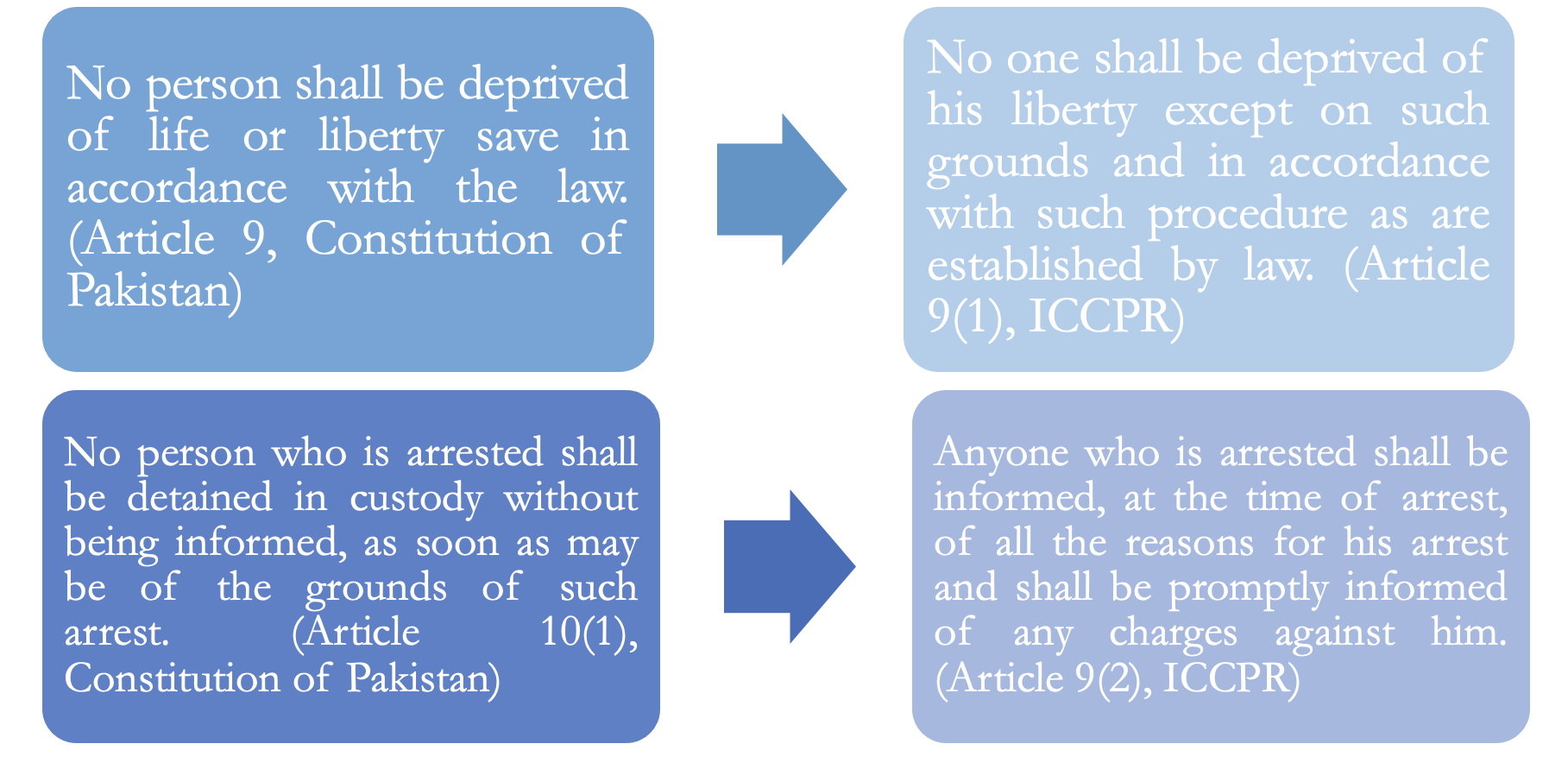
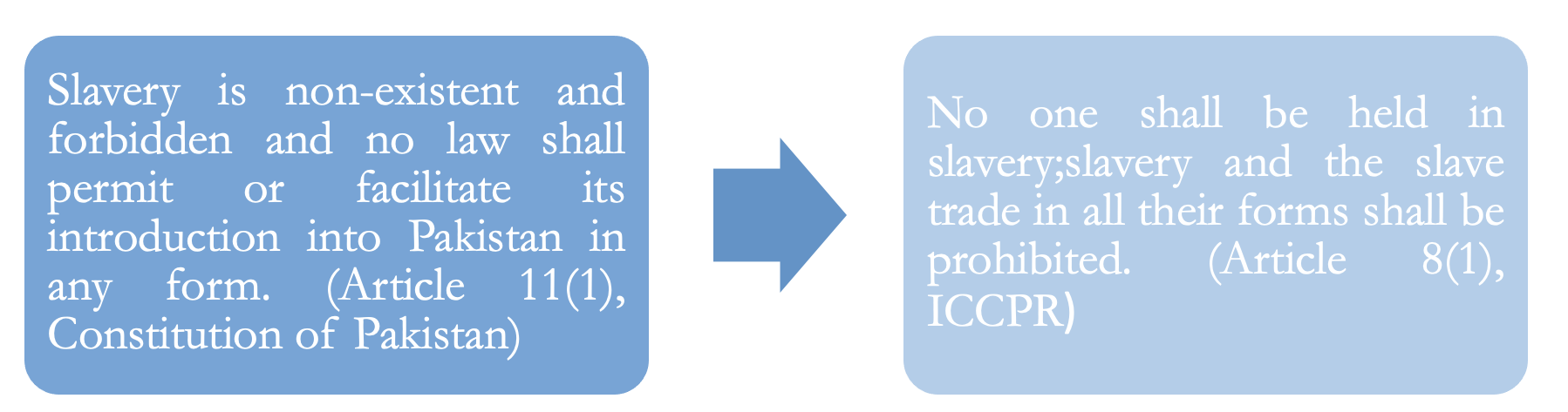
| Figure 1.2 – International Human Rights Instruments and Corresponding Constitutional Provisions |
International Law is widely entrenched in the domestic legal framework of Pakistan. There are various pieces of domestic law that replicate international law almost verbatim. The chapter on Fundamental Rights in the Constitution of Pakistan is identical to some of the provisions of the ICCPR. There are several other laws in Pakistan which closely correspond with provisions of international treaties which Pakistan has ratified. A few examples include:
| INTERNATIONAL INSTRUMENT | CORRELATING DOMESTIC LAW |
| Chapter VII of the United Nations Charter and all subsequent Security Council Resolutions | United Nations (Security Council) Act 1948 |
| Freedom of Association and Protection of the Right to Organize Convention, 1948 and Right to Organize and Collective Bargaining Convention, 1949 | Industrial Relations Ordinance 1969 |
| Certain provisions of the International Covenant on Civil and Political Rights and United Nations Standard Minimum Rules for the Treatment of Prisoners The United Nations Rules for the Treatment of Women Prisoners and Non-custodial Measures for Women Offenders, more commonly known as “Bangkok rules”. | Pakistan Prison Rules 1978 |
| Convention for the Suppression of Financing of Terrorism, International Convention for the Suppression of Terrorist Bombings and Security Council Resolutions 1267, 1373, 1456 | Anti-Terrorism Act 1997 |
| United Nations Convention against Transnational Organized Crime, United Nations Convention against Corruption and Financial Action Task Force (FATF) Recommendations | Anti-Money Laundering Act 2010 |
| General Agreement on Tariffs and Trade | Anti-Dumping Duties Act 2015 |
| Afghanistan-Pakistan Transit Trade Agreement | Afghanistan-Pakistan Transit Trade Rules 2011 |
| Common Article 3 to the Geneva Conventions and Customary International Humanitarian Law | Actions (in Aid of Civil Power) Regulations 2011 |
| Framework Convention on Tobacco Control | Prohibition of Smoking and Protection of Non-Smokers Health Ordinance 2002 |
| Chemical Weapons Convention | Chemical Weapons Convention Implementation Ordinance 2000 |
| United Nations Framework Convention on Climate Change and Kyoto Protocol | Environmental Protection Act 1997 |
| Chicago Convention on International Civil Aviation | Civil Aviation Authority Ordinance 1982 |
| United Nations Convention on the Law of the Sea | Territorial Waters and Maritime Zones Act 1976 |
| Convention for the Protection of Cultural Property in the Event of Armed Conflict | Antiquities Act 1975 |
| Vienna Convention on Diplomatic Relations 1961 | Diplomatic and Consular Privileges Act 1972 |
| United Nations Convention on the Carriage of Goods by Sea | Carriage of Goods by Sea Act 1925 |
| Figure 1.3 – International Instruments and Corresponding Domestic Laws |
The fact that some provisions directly reference international instruments within their actual text indicates the willingness of the legislature to comply with international law and acute cognizance of the need to implement international law as well.
Notes & references (1)
- Article 268 (7) of the Constitution of Islamic Republic of Pakistan, “In this Article, “existing laws” means all laws (including Ordinances, Orders-in-Council, Orders, rules, by-laws, regulations and Letters Patent constituting a High Court, and any notifications and other legal instruments having the force of law) in force in Pakistan or any part thereof, or having extraterritorial validity, immediately before the commencing day.”↩